Enter the query into the form above. You can look for specific version of a package by using @ symbol like this: gcc@10.
API method:
GET /api/packages?search=hello&page=1&limit=20
where search is your query, page is a page number and limit is a number of items on a single page. Pagination information (such as a number of pages and etc) is returned
in response headers.
If you'd like to join our channel search send a patch to ~whereiseveryone/toys@lists.sr.ht adding your channel as an entry in channels.scm.
This package provides the ShortText type which is suitable for keeping many short strings in memory. This is similar to how ShortByteString relates to ByteString.
The main difference between Text and ShortText is that ShortText uses UTF-8 instead of UTF-16 internally and also doesn't support zero-copy slicing (thereby saving 2 words). Consequently, the memory footprint of a (boxed) ShortText value is 4 words (2 words when unboxed) plus the length of the UTF-8 encoded payload.
This package provides a quasiquoter for raw string literals, i.e. string literals that don't recognise the standard escape sequences. Basically, they make your code more readable by freeing you from the responsibility to escape backslashes. They are useful when working with regular expressions, DOS/Windows paths and markup languages (such as XML).
A data-type like Either but with differing properties and type-class instances.
Library support is provided for this different representation, including lens-related functions for converting between each and abstracting over their similarities.
The Validation data type is isomorphic to Either, but has an instance of Applicative that accumulates on the error side. That is to say, if two (or more) errors are encountered, they are appended using a Semigroup operation.
As a consequence of this Applicative instance, there is no corresponding Bind or Monad instance. Validation is an example of, "An applicative functor that is not a monad."
Utilities to parse, print, diff, and analyse data in CoNLL-U, a format used in linguistics to represent the syntactic annotation of sentences. See https://universaldependencies.org/format.html
Alex is a tool for generating lexical analysers in Haskell. It takes a description of tokens based on regular expressions and generates a Haskell module containing code for scanning text efficiently. It is similar to the tool lex or flex for C/C++.
This library is for working with \".tar\" archive files. It can read and write a range of common variations of the tar archive format including V7, POSIX USTAR and GNU formats. It provides support for packing and unpacking portable archives. This makes it suitable for distribution but not backup because details like file ownership and exact permissions are not preserved. It also provides features for random access to archive content using an index.
This library provides typeclasses for rendering ghc-commonmark to Pandoc types.
This package provides a modular backend for rendering diagrams created with the diagrams embedded domain-specific language (EDSL) to Scalable Vector Graphics (SVG) files.
This package provides Haskell bindings to your system's native wcwidth and a command line tool to examine the widths assigned by it. The command line tool can compile a width table to Haskell code that assigns widths to the Char type.
This Haskell package provides a lens library, just like ghc-lens, but smaller. It provides essential lenses and traversals (like _1 and _Just), as well as ones which are simply nice to have (like each, at, and ix), and some combinators (like failing and singular), but everything else is stripped. As the result, this package has no dependencies.
Monad classes using type families, with instances for various monad transformers, inspired by the paper 'Functional Programming with Overloading and Higher-Order Polymorphism', by Mark P Jones. This package is almost a compatible replacement for the mtl-tf package.
This package provides a pipe-based interface to the Aspell program (no dynamic linking required).
This package provides a simple applicative parser in Parsec style.
This package defines classes of monads that can perform multiple executions in parallel and combine their results. For any monad that's an instance of the class, the package re-implements a subset of the Control.Monad interface, but with parallel execution.
This package provides several functions to quickly search for substrings in strict or lazy ByteStrings. It also provides functions for breaking or splitting on substrings and replacing all occurrences of a substring (the first in case of overlaps) with another.
__This package is deprecated__. Please, use genByteString from the [random package (version >=1.2)](https://hackage.haskell.org/package/random) instead. . Efficient generation of random bytestrings. The implementation populates uninitialized memory with uniformily distributed random 64 bit words (and 8 bit words for remaining bytes at the end of the bytestring). . Random words are generated using the PRNG from the [mwc-random](https://hackage.haskell.org/package/mwc-random) package or the [pcg-random](https://hackage.haskell.org/package/pcg-random) package. It is also possible to use a custom PRNG by providing an instance for the RandomWords type class and using the function generate from the module "Data.ByteString.Random.Internal". . The generated byte strings are suitable for statistical applications. They are /not/ suitable for cryptographic applications. . 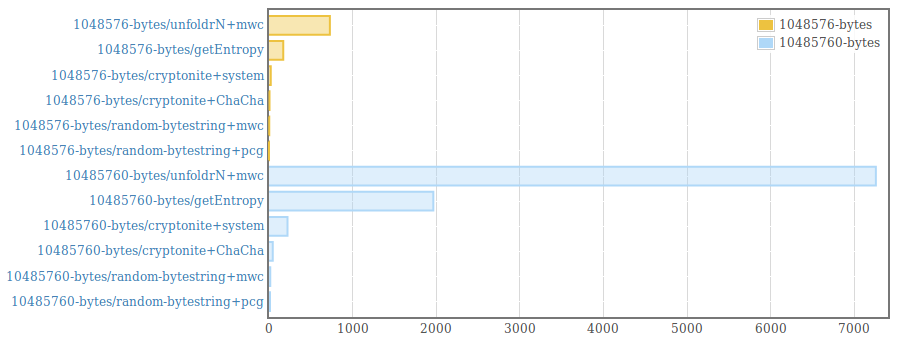 . 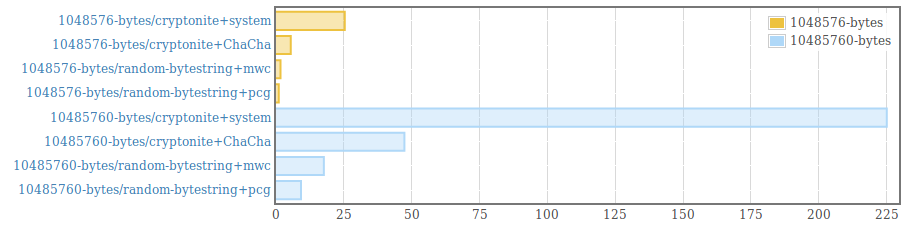
Safe conversions between textual types
This package provides extensible exceptions for both new and old versions of GHC (i.e., < 6.10).
This library contains scalable timer functions provided by a timer manager.
The threadDelay and timeout functions from the Haskell base library use the bounded Int type for specifying the delay or timeout period. This package provides alternative functions which use the unbounded Integer type.
This library provides backend-agnostic generation of client functions. For more information, see the README.
This Haskell package defines typeclasses used for converting Haskell data types to and from HTTP API data.
This package provides Data.Scientific, which provides the number type Scientific. Scientific numbers are arbitrary precision and space efficient. They are represented using scientific notation.