Enter the query into the form above. You can look for specific version of a package by using @ symbol like this: gcc@10.
API method:
GET /api/packages?search=hello&page=1&limit=20
where search is your query, page is a page number and limit is a number of items on a single page. Pagination information (such as a number of pages and etc) is returned
in response headers.
If you'd like to join our channel search send a patch to ~whereiseveryone/toys@lists.sr.ht adding your channel as an entry in channels.scm.
This library is for working with \".tar\" archive files. It can read and write a range of common variations of the tar archive format including V7, POSIX USTAR and GNU formats. It provides support for packing and unpacking portable archives. This makes it suitable for distribution but not backup because details like file ownership and exact permissions are not preserved. It also provides features for random access to archive content using an index.
This package provides a regular expression toolkit for regex-base with compile-time checking of regular expression syntax, data types for matches and captures, a text replacement toolkit, portable options, high-level AWK-like tools for building text processing apps, regular expression macros with parsers and test bench, comprehensive documentation, tutorials and copious examples.
Haskell library for recording and replaying HTTP interactions, making your tests fast, deterministic, and free from real network dependencies.
C->Haskell assists in the development of Haskell bindings to C libraries. It extracts interface information from C header files and generates Haskell code with foreign imports and marshaling. Unlike writing foreign imports by hand (or using hsc2hs), this ensures that C functions are imported with the correct Haskell types.
The functions for creating temporary files and directories in the Haskelll base library are quite limited. This library just repackages the Cabal implementations of its own temporary file and folder functions so that you can use them without linking against Cabal or depending on it being installed.
This library provides Mustache templates for Haskell based on the stache library using parsec instead of megaparsec.
vty is a terminal GUI library in the niche of ncurses, intended to be easy to use and to provide good support for common terminal types.
This package provides an API to Haddock, the documentation-generation tool for Haskell libraries.
This library provides the natural numbers for Haskell.
This Haskell library provides a purely functional interface for statistics based on hmatrix and GSL.
Difference lists are a list-like type supporting O(1) append. This is particularly useful for efficient logging and pretty printing (e.g. with the Writer monad), where list append quickly becomes too expensive.
This package provides a family of combinators for defining webservices APIs and serving them . You can learn about the basics in the <http://docs.servant.dev/en/stable/tutorial/index.html tutorial>. . <https://github.com/haskell-servant/servant/blob/master/servant-server/example/greet.hs Here> is a runnable example, with comments, that defines a dummy API and implements a webserver that serves this API, using this package. . <https://github.com/haskell-servant/servant/blob/master/servant-server/CHANGELOG.md CHANGELOG>
The functional graph library, FGL, is a collection of type and function definitions to address graph problems. The basis of the library is an inductive definition of graphs in the style of algebraic data types that encourages inductive, recursive definitions of graph algorithms.
ghc-blaze-textual is a fast Haskell library for rendering common Haskell datatypes in text form using the ghc-blaze-builder library.
__This package is deprecated__. Please, use genByteString from the [random package (version >=1.2)](https://hackage.haskell.org/package/random) instead. . Efficient generation of random bytestrings. The implementation populates uninitialized memory with uniformily distributed random 64 bit words (and 8 bit words for remaining bytes at the end of the bytestring). . Random words are generated using the PRNG from the [mwc-random](https://hackage.haskell.org/package/mwc-random) package or the [pcg-random](https://hackage.haskell.org/package/pcg-random) package. It is also possible to use a custom PRNG by providing an instance for the RandomWords type class and using the function generate from the module "Data.ByteString.Random.Internal". . The generated byte strings are suitable for statistical applications. They are /not/ suitable for cryptographic applications. . 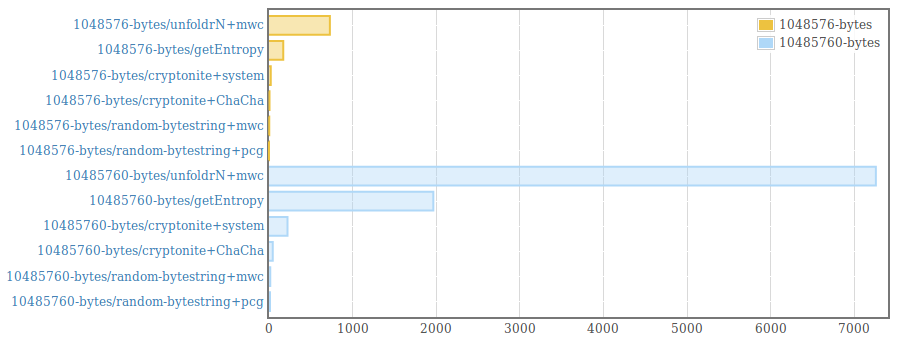 . 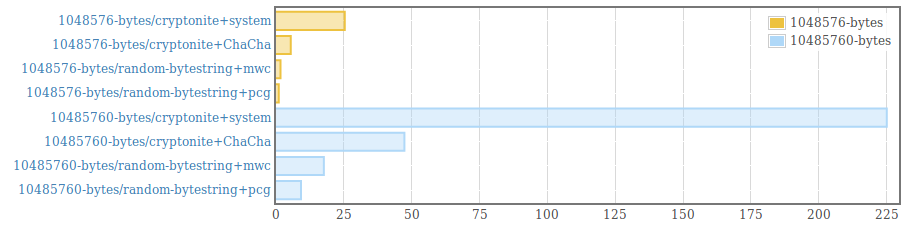
This package provides a newtype over Bool with a Vector instance that requires only 1/8 of the normal memory and is in some cases much faster.
This package provides a simple text templating system used by pandoc.
This package provides Haskell modules to allow use of Accessor to access state in transformers State monad.
This package provides Haskell bindings to your system's native wcwidth and a command line tool to examine the widths assigned by it. The command line tool can compile a width table to Haskell code that assigns widths to the Char type.
GNU ncurses is a library for creating command-line application with pseudo-graphical interfaces. This package is a nice, modern binding to GNU ncurses.
This package provides bindings to the ALSA simple mixer API.
This package provides functions for converting emoji names to emoji characters and vice versa.
How does it differ from the emoji package?
It supports a fuller range of emojis, including all those supported by GitHub
It supports lookup of emoji aliases from emoji
It uses Text rather than String
It has a lighter dependency footprint: in particular, it does not require aeson
It does not require TemplateHaskell
This package provides an interface to the directory package for users of path. It also implements some missing stuff like recursive scanning and copying of directories, working with temporary files/directories, and more.
Haskell library for opening the web browser.